Speed Ratings
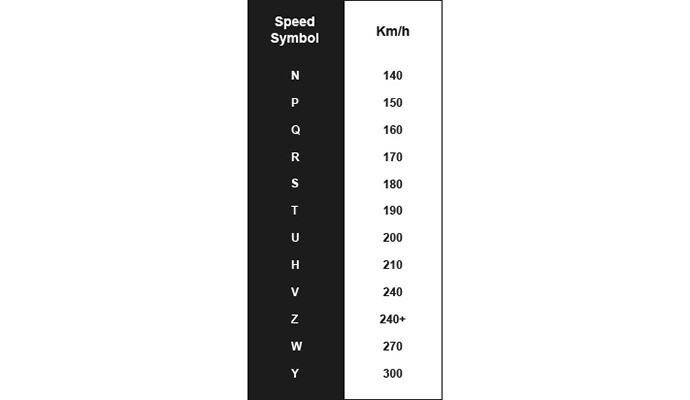
The speed rating of a tyre is displayed on the sidewall of your tyre within the tyre code. It is represented by a letter of the alphabet. Once you know your tyre speed rating, you can work out what is the maximum speed your tyre is capable of maintaining on the road. Speed ratings are based on engineer tests run to find out what speed can be safely maintained at length.
Where do find the Speed Rating within the Tyre Code?
The Speed Rating features in the sequence of measurements of the tyre code. It is near the end of the tyre code and usually comes after the Load Index, (which follows the Tyre Size). Below is an exception to this rule where the speed rating comes before the Tyre Size.
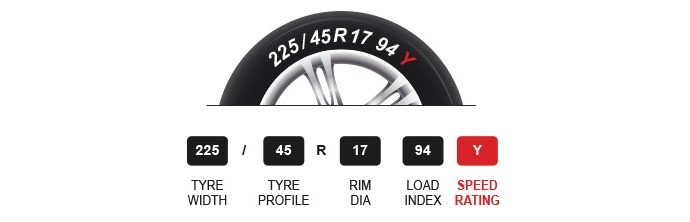
Speed Rating: an anomaly
This is unusual, but with some top range and vintage cars, the wheel construction and speed rating come after the Aspect Ratio rather than the Load Index. Speed Ratings are most frequently found after the Load Index which follows both the Tyre Size and Aspect Ratio.
In this case however, after the two digits of the Aspect Ratio are the two letters R and Z combined. These letters are used to represent the internal construction of the tyre and its speed rating. Most Passenger tyres are radial tyres and are represented by an R.
As for the Z, speed ratings mainly feature letters that come towards the end of the alphabet. The standard of these ratings is that the closer to the end of the alphabet the letter is, the higher the speed rating of the tyre. This is not an airtight rule however. So Z at the time it was chosen, denoted what was thought to be the fastest speed rating possible for a tyre. Considering this, the rating RZ is like an outdated, sports car tyre speed rating, which has just hung around despite faster ratings having been created since.
Frequently Asked Questions
What is a tyre speed rating?
It's a letter showing the maximum speed a tyre can safely sustain while carrying its rated load — for example H is up to 210km/h, V up to 240 and W up to 270. The tyre is tested to that limit, so the rating reflects how much heat and stress its construction can handle.
Where do I find my tyre's speed rating?
It's the last letter in the code on the sidewall (e.g. the V in 205/55 R16 91V). Your vehicle placard and owner's manual also list the recommended rating — the safest reference for what the car needs.
Can I use a lower speed rating than recommended?
No. Fitting a lower speed rating than your vehicle specifies can be unsafe and may be illegal, because the tyre isn't built to handle the heat your car can generate — and it can void insurance. Always match or exceed the manufacturer's rating.
Does a higher speed rating mean a better tyre?
Not necessarily. A higher rating usually means a stiffer, sportier construction, which suits performance driving but can give a firmer ride and faster wear. It doesn't make a tyre 'better' for everyday use — the right rating is the one that matches your car.
Should all four tyres have the same speed rating?
Yes. Mixing speed ratings can upset handling balance, because the tyres respond differently at speed. Keep all four the same, and never fit below your placard's specification, even on a spare you intend to use long-term.
- Speed rating = maximum safe sustained speed (e.g. V = 240km/h).
- Found on the sidewall and the placard.
- Never go below your placard's rating — unsafe and possibly illegal.
- Keep all four tyres matched.